
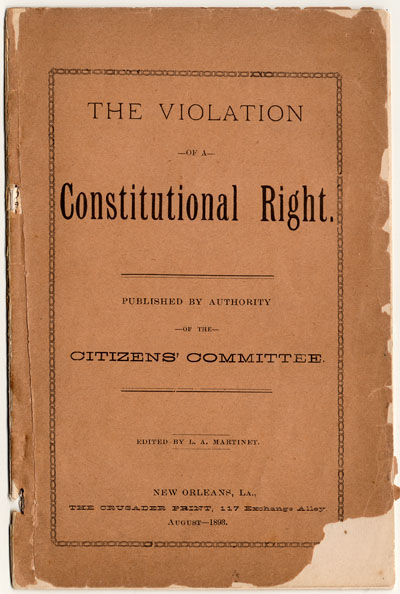
In 1892, Homer Plessy bought a first-class ticket on a Louisiana train, took a seat in the whites-only car, and was arrested. The arrest was planned. A group of New Orleans citizens, the Comité des Citoyens, wanted to challenge Louisiana’s 1890 Separate Car Act, which required “equal but separate” railway accommodations by race. Plessy lost in the state courts, including before Judge John Howard Ferguson, and appealed. In 1896, the U.S. Supreme Court upheld the law seven to one.
To understand why, it helps to follow the argument that won. This post lays out that reasoning, because understanding it is how we learn to recognize it.
The Argument from Police Power
Louisiana’s defense rested on the “police power,” a state’s authority to pass reasonable laws protecting public health, safety, and order. The state argued that separating passengers was an ordinary use of that power. Because the law required equal accommodations for both races, it claimed no one was denied anything.
Custom as Proof of Reasonableness
The harder question was what counts as “reasonable.” Writing for the majority, Justice Henry Billings Brown said reasonableness could be measured by the “established usages, customs, and traditions of the people.” In other words, if separation was already common, it was reasonable.
Brown pointed to examples. Massachusetts had upheld segregated schools in Roberts v. City of Boston (1849), and Congress had maintained separate schools in Washington, D.C. If those practices were lawful, the Court reasoned, a separate railcar was too.
Legal Equality vs. Social Equality
The majority also drew a line between two kinds of equality. The Fourteenth Amendment, Brown wrote, was meant to secure legal equality, not to abolish distinctions based on color or enforce social mixing. He added that social prejudice could not be overcome by legislation.
On the claim that segregation stamped Black citizens with a badge of inferiority, Brown said any such meaning existed only because Black Americans chose to put that construction on it.

Where the Argument Breaks Down
This is where the case becomes useful for a class on freedom. The reasoning has a built-in problem: custom is made by those with power. If tradition defines what is reasonable, then a majority’s habits can justify nearly anything, and the people harmed by those habits have no way to challenge them.
Justice John Marshall Harlan saw this in his lone dissent. He wrote that the Constitution is “color-blind” and knows no caste, and that everyone understood the law’s real purpose was to keep Black citizens in a subordinate place. He predicted the decision would prove as harmful as Dred Scott.
History largely agreed with him. The “separate but equal” doctrine spread through schools, transportation, and public life, and the facilities were rarely equal. In Brown v. Board of Education (1954), the Court held that separate educational facilities are inherently unequal, undercutting Plessy’s foundation.


No comments:
Post a Comment