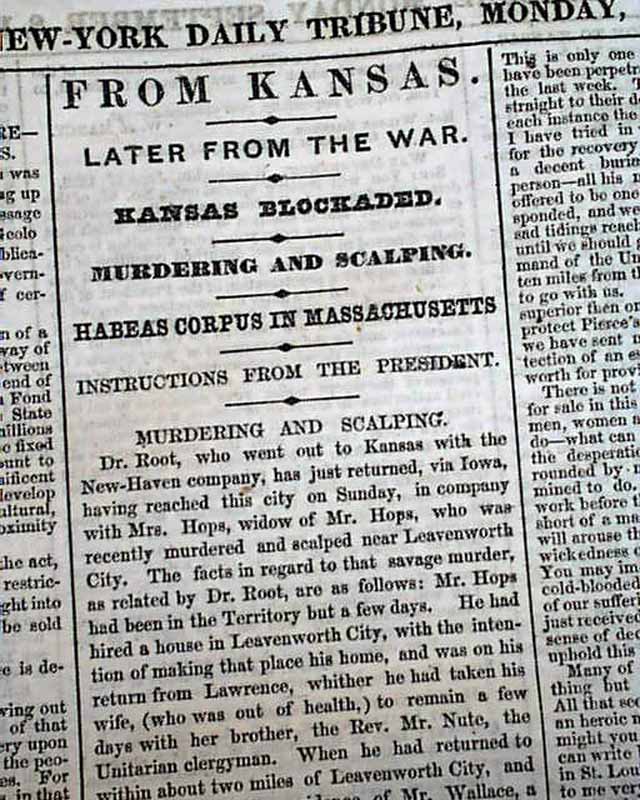
Bleeding Kansas refers to the period of political violence, roughly 1854 to 1859, that erupted in the Kansas Territory over whether it would enter the Union as a free or slave state.
The conflict was set in motion by the Kansas-Nebraska Act of 1854, sponsored by Illinois Senator Stephen Douglas. That law organized the Kansas and Nebraska territories and, critically, repealed the Missouri Compromise of 1820, which had banned slavery north of the 36°30' line.
In its place, the act introduced the principle of "popular sovereignty," meaning the settlers of each territory would vote on whether to permit slavery themselves.
It sounded democratic on paper. In practice, it turned Kansas into a battleground, because both pro-slavery and anti-slavery forces understood that whoever controlled the vote would control the territory's future, and possibly the sectional balance of power in Congress.
What followed was essentially a rush to stack the population. Northern abolitionist groups, most notably the Massachusetts-based New England Emigrant Aid Company, funded and organized free-state settlers to move to Kansas. Pro-slavery Missourians, living just across the border, responded by crossing into Kansas in large numbers to vote illegally and intimidate free-state settlers; they became known as "Border Ruffians."
The result was two rival governments claiming legitimacy at once: a pro-slavery legislature at Lecompton, and a free-state legislature at Topeka, each with its own constitution.
The violence that gave the period its name came in waves.
In May 1856, pro-slavery forces raided the free-state stronghold of Lawrence, burning buildings and destroying printing presses in what's known as the "Sack of Lawrence." Just days later, radical abolitionist John Brown led a nighttime raid along Pottawatomie Creek, dragging five pro-slavery settlers from their homes and killing them with broadswords, an event known as the Pottawatomie Massacre.
Skirmishes, arson, and killings continued for years, with death toll estimates ranging from around 55 to as high as 200, depending on the source and how "related violence" is counted. The term "Bleeding Kansas" itself is usually credited to New York Tribune editor Horace Greeley.
The Kansas conflict didn't stay contained to the territory. It bled directly into the U.S. Senate. In May 1856, Senator Charles Sumner of Massachusetts delivered a fiery speech condemning pro-slavery violence in Kansas and personally insulted South Carolina Senator Andrew Butler.
Two days later, Butler's cousin, Congressman Preston Brooks, beat Sumner nearly to death with a cane on the Senate floor. Sumner needed years to recover, and Brooks became something of a hero in the South, a reaction that stunned many Northerners.
Why does this matter for a history class? Bleeding Kansas is often described as a "dress rehearsal" or preview for the Civil War, and that framing holds up well.
First, it exposed popular sovereignty as a failure: rather than defusing the slavery question through local democracy, it turned that democracy into a target for fraud and violence.
Second, it accelerated the collapse of the existing two-party system. The Whig Party, already strained, disintegrated, and the new Republican Party formed largely around opposition to the expansion of slavery into the territories, using Kansas as a rallying point.
Third, it radicalized figures on both sides. John Brown, having tasted violence in Kansas, went on to lead the 1859 raid on Harpers Ferry, an act that further inflamed Southern fears of Northern-backed slave insurrection.
Finally, the competing Lecompton and Topeka constitutions forced Congress to take sides, further dividing Democrats along sectional lines, a split that helped hand the presidency to Abraham Lincoln in 1860.
Kansas itself was eventually admitted to the Union as a free state on January 29, 1861, just weeks before the Civil War began.
By then, the violence in the territory had already demonstrated something the nation could not walk back: the slavery question was not going to be settled by compromise or by vote. It was going to be settled by force.
In that sense, Bleeding Kansas isn't just a regional conflict, it's the moment the abstract argument over slavery's expansion turned into actual bloodshed on American soil, years before Fort Sumter.
AI DISCLOSURE: AI was used. I put in a prompt to tell me about Bleeding Kanas and then did research on it. I used Claude AI to help me clean up the text for grammar, spelling, and punctuation. I also asked the tool to help me shape it into the form of a blog post. I then edited the text, added links, and added images with end captions.


No comments:
Post a Comment