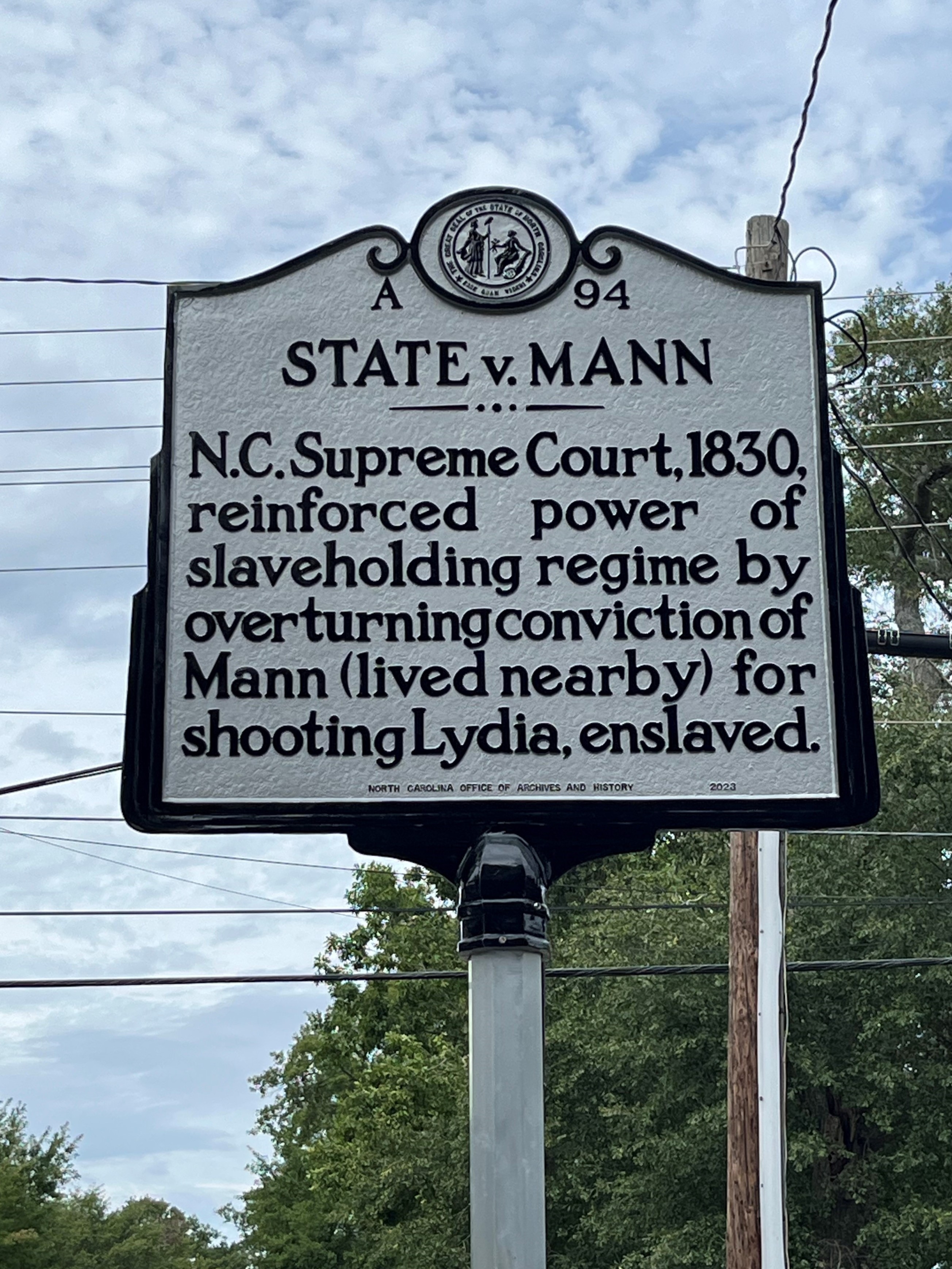
In class, we held a mock trial built around one of the most troubling cases in American legal history, State v. Mann. The North Carolina Supreme Court heard it in 1829, in an America that believed it could be better but had not yet decided to become so.
The case asks a question that still matters: who does the law protect, and who does it leave out?
The facts are short and hard to read. John Mann, a white man in Chowan County, North Carolina, had hired an enslaved woman named Lydia from her owner for a year.
Mann was not her owner, only her temporary master. When he moved to punish her, Lydia ran. Mann shot her as she fled.
Local authorities treated the shooting as a crime. A grand jury indicted Mann for assault and battery, and the trial judge told jurors that if the punishment was cruel and out of proportion to Lydia's offense, Mann was guilty, especially since he was not her owner. The jury agreed. The penalty was a fine of five dollars.
That number deserves a moment of attention.
Five dollars measured what the state thought Lydia's suffering was worth, and it was worth almost nothing. The law was willing to notice the harm, but not to take it seriously.
Even so, Mann refused to pay. He appealed to the state's highest court, insisting that the fine was unfair and that the state had no right to punish him at all.
That is where our mock trial began.
The State argued that the case had to be understood inside its moment. Around 1830, the country was in a period of moral awakening.
Religion carried real weight in daily life, and that spiritual energy was feeding the growing abolition movement. Churches and town hall meetings became places of self-reflection and moral courage, where ordinary people asked whether the nation could live up to its own ideals.
The State also made a practical point: slavery slowed overall economic development, so it was neither just nor wise.
Mann's lawyers answered with a cold, simple theory. Enslaved people, they argued, were property. Property cannot feel pain. Property has no human rights. If those three sentences were true, then Lydia had been wronged no more than a broken tool.
They were not true, of course, but the law of that era gave them enormous force.
The real Supreme Court sided with Mann. Justice Thomas Ruffin wrote the opinion and reversed the conviction, declaring that the master's power had to be absolute. Ruffin did not hide his discomfort.
Historians note that he had little sympathy for slavery as a matter of personal feeling, yet he wrote one of the harshest pro-slavery opinions ever issued by a state court. He also extended that absolute power to a hirer like Mann, who did not even own Lydia.
The decision did not end the moral argument. It did the opposite.
Abolitionists in the 1850s pointed to State v. Mann as proof of what slavery did to the law itself: it turned judges into defenders of violence and turned the courtroom into a place where a wounded woman had no standing.
Here is what I take from the trial.
The State's arguments about conscience, religion, and moral courage were the ones history would eventually vindicate. But the law of the day sided with the man who claimed a person was property.
That gap between what people believed was right and what the law allowed is exactly why the abolition movement mattered. A nation can believe it is capable of better long before its institutions agree.
Freedom did not arrive on its own. It was argued for, in churches, in town halls, and in courtrooms, by people willing to say that the law was wrong.

AI DISCLOSURE: AI was used in a limited way. I put in all my notes and asked AI to turn it into a blog post. I used Claude AI to help me clean up the text for grammar, spelling, and punctuation. I then edited the text, added links, and added images with end captions.


No comments:
Post a Comment